
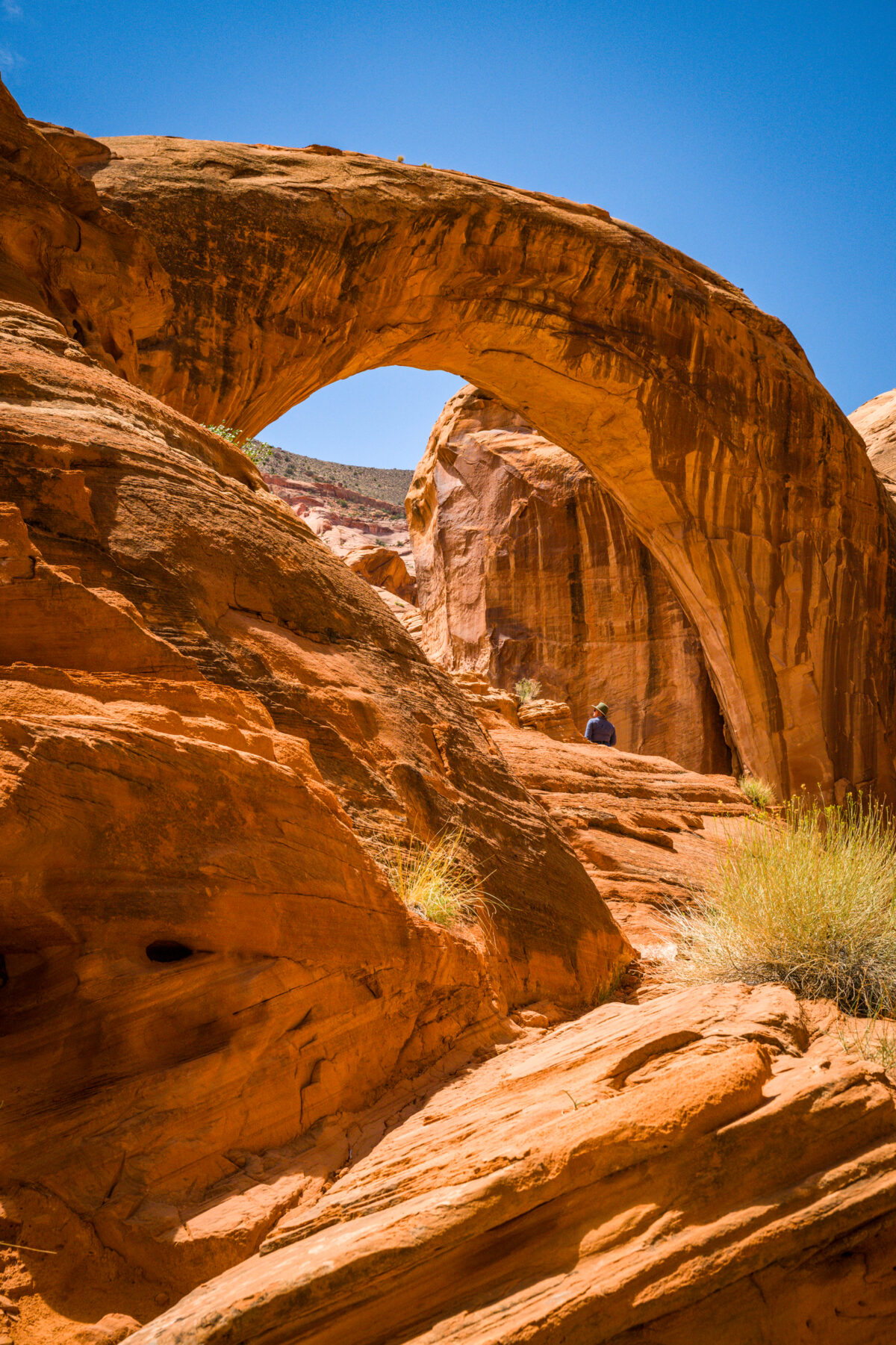
When people think about visiting Lake Powell, attractions like Horseshoe Bend, Antelope Canyon, and boating across the lake usually come to mind first. While these iconic destinations certainly deserve their reputation, there’s another remarkable landmark tucked deep within the sandstone canyons of southern Utah that many visitors overlook.
Rainbow Bridge National Monument is one of the largest known natural bridges in the world and has inspired visitors for generations. Towering high above the desert floor, this incredible sandstone formation is more than just an impressive geological feature. It is a place of cultural importance, natural beauty, and rich history that has been treasured by Native American tribes for centuries.
Whether you’re planning your first trip to Lake Powell, researching the monument before your visit, or simply curious about one of the Southwest’s most fascinating landmarks, understanding the story behind Rainbow Bridge makes the experience even more meaningful.
What Is Rainbow Bridge National Monument?
Rainbow Bridge is a massive natural bridge carved from Navajo Sandstone, the same type of sandstone that forms many of the dramatic cliffs and canyons throughout northern Arizona and southern Utah.
Although people sometimes refer to it as an arch, Rainbow Bridge is technically classified as a natural bridge because it was primarily formed by flowing water rather than wind erosion.
According to the National Park Service, Rainbow Bridge rises approximately 290 feet high and spans about 275 feet, making it one of the largest known natural bridges on Earth. Its opening measures approximately 42 feet wide and 33 feet thick at the top, creating an enormous sandstone arch that has stood for thousands of years (National Park Service).
Standing beneath the bridge, visitors often comment that photographs simply don’t capture its true size. The scale becomes apparent only when people stand nearby and realize just how massive the formation really is.
How Was Rainbow Bridge Formed?
One of the most fascinating aspects of Rainbow Bridge is how nature created it.
Millions of years ago, the area looked dramatically different than it does today. Layers of sand accumulated across an ancient desert, eventually compressing into the Navajo Sandstone that now dominates much of the Colorado Plateau.
Over time, water became the sculptor.
Ancient streams slowly carved their way through the sandstone, gradually widening cracks and weakening sections of rock. As erosion continued over countless centuries, softer rock wore away while stronger portions remained. Eventually, the stream carved completely through the rock, leaving behind the spectacular bridge we see today.
Even today, the forces that created Rainbow Bridge continue shaping the surrounding landscape. Wind, rain, temperature changes, and flowing water all play a role in slowly altering the sandstone throughout the region.
It’s a reminder that landscapes like Lake Powell, Glen Canyon, and Rainbow Bridge are not frozen in time. They’re constantly evolving, even if those changes happen too slowly for us to notice during a single visit.
A Sacred Place for Native American Tribes
Rainbow Bridge is much more than an impressive geological landmark.
For many Native American tribes, including the Navajo, Hopi, Paiute, San Juan Southern Paiute, Ute Mountain Ute, and Zuni, the bridge is considered a sacred place with deep spiritual significance.
Long before it became a national monument, Indigenous peoples visited the bridge for ceremonies, prayer, and cultural traditions. Many tribal members continue to view Rainbow Bridge as a place deserving of respect and reverence today.
Because of this significance, the National Park Service encourages visitors to treat the monument with care. Visitors are asked to remain on designated trails, respect cultural traditions, and avoid walking beneath the bridge whenever possible out of respect for the beliefs of affiliated tribes (National Park Service).
Learning about this cultural importance helps visitors appreciate that Rainbow Bridge is more than a beautiful destination. It is also a place with thousands of years of human history.
How Rainbow Bridge Became a National Monument
Although Native American communities had known about Rainbow Bridge for centuries, it remained largely unknown to much of the United States until the early 1900s.
In 1909, an expedition led by explorer John Wetherill, along with Paiute guide Nasja Begay and Professor Byron Cummings, successfully documented the bridge after an expedition through the rugged canyon country of southern Utah.
The discovery attracted national attention because of the bridge’s extraordinary size and beauty.
Just one year later, in 1910, President William Howard Taft designated Rainbow Bridge as a National Monument, helping preserve it for future generations (National Park Service History).
Today, Rainbow Bridge National Monument remains one of the most unique units within the National Park System, protecting both its remarkable geology and its cultural significance.
Why Rainbow Bridge Is So Unique
The American Southwest is filled with incredible sandstone formations, arches, and canyons. So what makes Rainbow Bridge stand apart?
Part of the answer is simply its size.
Very few natural bridges in the world approach Rainbow Bridge’s dimensions. Its graceful curve appears almost perfectly symmetrical, creating one of the most recognizable natural landmarks in the Southwest.
But its location also adds to the experience.
Unlike many popular attractions that sit just off major highways, Rainbow Bridge feels remote. Reaching it requires a bit more planning, which helps preserve the peaceful atmosphere visitors often describe after arriving.
Surrounded by towering canyon walls, desert vegetation, and dramatic sandstone cliffs, it’s easy to understand why this place has inspired awe for generations.
Rainbow Bridge and Lake Powell
Today, Lake Powell plays an important role in how most visitors experience Rainbow Bridge.
Before the creation of Lake Powell, reaching the monument required long hikes through rugged canyon country. While hiking routes still exist, the majority of visitors now arrive by boat, traveling through the winding waterways of Glen Canyon National Recreation Area before reaching the monument.
For many people, the journey becomes just as memorable as the destination.
Cruising through narrow sandstone canyons, watching the cliffs rise from the water, and experiencing the changing colors of the desert landscape creates an unforgettable approach to one of America’s most remarkable natural landmarks.
And because the trip combines both scenic boating and a visit to Rainbow Bridge, visitors get to experience two of Lake Powell’s greatest attractions in a single adventure.